
Why Commercial Building Owners Need Ordinance or Law Coverage in New Jersey

Bergen Insurance Group | Commercial Property Insurance Education

Why Commercial Building Owners Need Ordinance or Law Coverage in New Jersey
Imagine your commercial building suffers a major fire.
The fire department leaves.
The insurance adjuster arrives.
Contractors begin preparing estimates.
Then the building department delivers unexpected news:
"You can't rebuild it the way it was."
For many commercial property owners, this is the moment they discover Ordinance or Law coverage.
While most building owners focus on replacement cost, deductibles, and premium, few realize that local building codes can create tens of thousands—or even hundreds of thousands—of dollars in additional expenses after a covered loss.
WHAT IS ORDINANCE OR LAW COVERAGE?
Ordinance or Law coverage helps pay for expenses that arise when a municipality requires a building to be demolished, upgraded, or rebuilt to comply with current building codes after a covered loss.
Without this coverage, many of those costs could become the property owner's responsibility.
This issue is especially important for:
Mixed-use buildings
Apartment buildings
Main Street retail properties
Older office buildings
Historic commercial properties
Many New Jersey commercial buildings were built decades before today's construction and safety standards existed.

REAL WORLD EXAMPLE
Let's assume you own a mixed-use building.
Retail space on first floor
Apartments above
Built in 1955
A fire damages approximately 60% of the structure.
You expect insurance to repair the damaged portion.
However, local code officials determine the building must now comply with current requirements.
Suddenly, additional costs begin appearing:
Demolition of undamaged sections
Electrical upgrades
Emergency lighting
Fire-rated construction
ADA accessibility improvements
Updated exits and stairways
The repair cost may be covered.
The code upgrade cost may not be covered.
That is exactly why Ordinance or Law coverage exists.

THE THREE PARTS OF ORDINANCE OR LAW COVERAGE
Coverage 1: Loss to the Undamaged Portion
Sometimes a municipality requires demolition of portions of the building that survived the loss.
Coverage 1 helps address the value of the undamaged section that must be removed.
Example
A fire damages 55% of the structure.
The town requires complete demolition.
The remaining 45% was never damaged.
Coverage 1 helps account for that loss.
Coverage 2: Demolition Cost Coverage
Coverage 2 pays for demolition and debris removal of the undamaged portions that must be torn down.
Example
Demolition contractor: $30,000
Debris removal: $15,000
Dumpsters and hauling: $10,000
Total demolition cost:
$55,000
Coverage 3: Increased Cost of Construction
This is often the most important part.
Coverage 3 helps pay the additional cost required to rebuild to current code.
Examples include:
Electrical upgrades
Fire protection improvements
ADA accessibility upgrades
Structural enhancements
Emergency lighting systems
Updated exits and egress requirements
⚠️ Common Mistake We See
One of the most common issues we discover when reviewing commercial property policies is inadequate Ordinance or Law coverage. Many older commercial buildings carry only $10,000 to $25,000 of coverage even though code-required demolition and rebuilding expenses can easily exceed $100,000 after a major loss.
WHY THIS MATTERS FOR OLDER NEW JERSEY BUILDINGS
Many commercial property owners assume:
"My building is insured for $1 million, so I'm fine."
Not necessarily.
A building can be adequately insured for reconstruction while still lacking enough Ordinance or Law coverage.
This is particularly true for:
Pre-1980 buildings
Downtown mixed-use properties
Older apartment buildings
Historic structures
Code compliance costs can become surprisingly expensive.
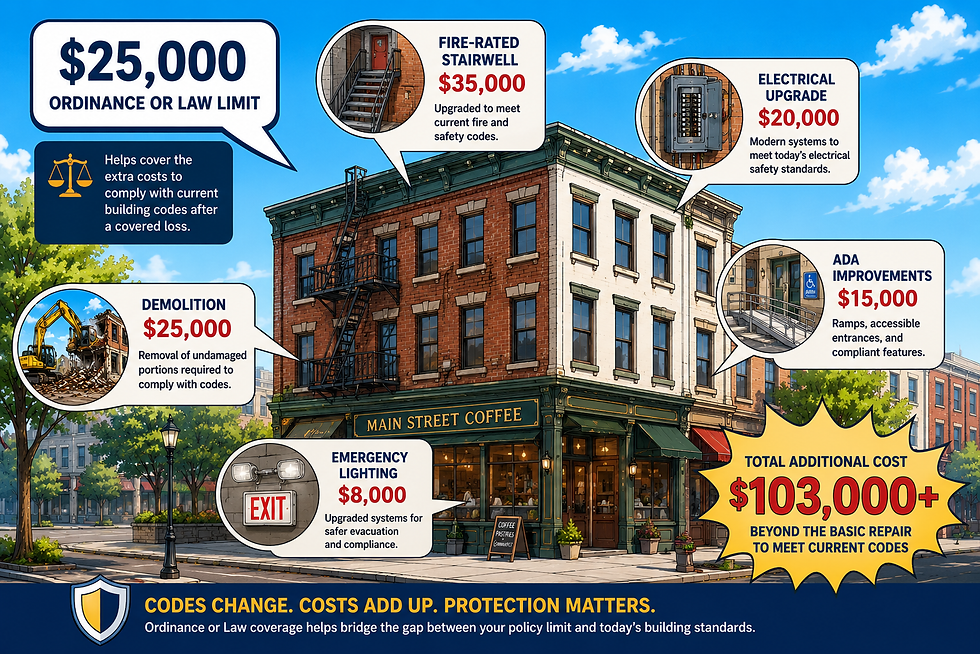
THE $25,000 PROBLEM
One issue we frequently encounter when reviewing commercial property policies is relatively low Ordinance or Law limits.
At first glance, $25,000 may seem reasonable.
However, consider the following example:
Expense | Cost |
Demolition | $25,000 |
Electrical Upgrades | $20,000 |
ADA Improvements | $15,000 |
Fire-Rated Construction | $35,000 |
Emergency Lighting | $8,000 |
Total: $103,000
In this scenario, a $25,000 limit leaves the building owner responsible for the remaining costs.
WHO SHOULD REVIEW THEIR COVERAGE?
Commercial property owners should pay particular attention to Ordinance or Law coverage if they own:
Mixed-use buildings
Apartment buildings
Retail buildings
Office buildings
Historic structures
Older commercial properties
The older the building, the more important the discussion becomes.
FAQS
Is Ordinance or Law coverage included automatically?
Some policies include limited coverage while others require it to be added separately. Coverage limits vary significantly by insurance company.
Does this coverage apply if there is no property damage?
No. Ordinance or Law coverage generally applies after a covered property loss triggers code enforcement requirements.
Is this only important for older buildings?
No, but older buildings typically face greater exposure because they are less likely to meet current building standards
.
Does it pay for voluntary remodeling projects?
No. Coverage generally applies only when upgrades are required by ordinance or law following a covered loss.
How much coverage should a commercial property owner carry?
The appropriate amount depends on the age, size, occupancy, location, and construction of the building. Property owners should review their individual circumstances with their insurance advisor.
Other Suggested Articles
DISCLAIMER
This article is intended for educational purposes only and should not be considered legal, financial, or insurance advice. Coverage varies by insurance company, policy form, endorsements, exclusions, conditions, and underwriting guidelines. Property owners should consult their insurance professional regarding their specific coverage needs.


Comments